PARENTS & HOMEOWNERS: MY 7-STEP ESTATE PLANNING PROCESS WILL PROTECT YOUR HEIRS
From Creditors, Predators & Bad Choices, And Will Help You Become a (Bigger) Hero to Your Family!


Joint Tenancy and Probate: Protecting California Families
{
“@type”: “Article”,
“image”: {
“url”: “https://csuxjmfbwmkxiegfpljm.supabase.co/storage/v1/object/public/blog-images/organization-1174/1766191899855_image_1766191899611.png”,
“@type”: “ImageObject”,
“alternateName”: “California family discussing estate documents”
},
“author”: {
“url”: “https://ridleylawoffices.com”,
“name”: “Ridleylawoffices”,
“@type”: “Organization”
},
“@context”: “https://schema.org”,
“headline”: “Joint Tenancy and Probate: Protecting California Families”,
“publisher”: {
“url”: “https://ridleylawoffices.com”,
“name”: “Ridleylawoffices”,
“@type”: “Organization”
},
“inLanguage”: “en”,
“articleBody”: “Joint tenancy and probate in California explained, including property transfer rules, legal risks, probate avoidance, and critical estate planning tips.”,
“description”: “Joint tenancy and probate in California explained, including property transfer rules, legal risks, probate avoidance, and critical estate planning tips.”,
“datePublished”: “2026-12-20T00:53:37.408Z”
}
More than half of American families eventually face tough choices about how to protect and transfer property. Decisions around home ownership are not just about finding the right house. They can influence taxes, future inheritance, and family stability. Understanding how joint tenancy works under California law gives American homeowners clarity and helps them avoid common mistakes that could lead to costly legal delays and family stress.
Table of Contents
- Joint Tenancy Defined in California Law
- How Joint Tenancy Avoids Probate Process
- Key Rights and Obligations of Co-Owners
- Risks and Downsides of Joint Tenancy
- Comparing Joint Tenancy to Living Trusts
Key Takeaways
| Point | Details |
|---|---|
| Joint Tenancy Defined | In California, joint tenancy allows equal ownership with a right of survivorship, facilitating seamless asset transfer upon death without probate. |
| Shared Responsibilities | All joint tenants share equal rights and financial obligations, necessitating collective decision-making for major actions related to the property. |
| Risks of Joint Tenancy | Potential creditor exposure and limited control over distribution may complicate estate planning, making it crucial to consult an estate planning attorney. |
| Comparison to Living Trusts | Living trusts offer enhanced flexibility and privacy for asset distribution, making them a more suitable option for complex family situations than joint tenancy. |
Joint Tenancy Defined in California Law
In California, joint tenancy represents a specialized form of property ownership with unique legal characteristics that can significantly impact estate planning and asset transfer. California Civil Code Section 683 defines joint tenancy as an ownership arrangement where two or more individuals hold equal interest in a property, created through a single transfer or will, with an explicit joint tenancy declaration.
The California legal framework recognizes joint tenancy through four critical unities: interest, title, time, and possession. What makes this ownership structure particularly distinctive is the right of survivorship – a crucial feature meaning that when one joint tenant passes away, their property interest automatically transfers to the surviving joint tenant(s). California property law ensures this transfer occurs without requiring probate, providing a streamlined mechanism for asset transition.
Joint tenancy creates a powerful estate planning tool for California families seeking to simplify property transfer and avoid complex legal processes. Unlike other ownership structures, joint tenants share equal rights and responsibilities, with each tenant possessing the entire property rather than a fractional interest. This means all joint tenants can use the entire property, make decisions collectively, and have an undivided stake in the asset.
Pro Tip – Legal Precision: Consult an experienced estate planning attorney to ensure your joint tenancy arrangement precisely matches your financial goals and family needs, as subtle legal nuances can dramatically impact long-term asset protection and inheritance strategies.
How Joint Tenancy Avoids Probate Process
Joint tenancy offers California families a powerful strategy for avoiding the complex probate process, providing a direct and efficient method of property transfer after an owner’s death. The key mechanism enabling this is the right of survivorship, a legal principle that automatically transfers property ownership to the surviving joint tenant(s) without requiring court intervention.
Property ownership transfer through joint tenancy bypasses traditional probate proceedings by creating an immediate transfer mechanism. When one joint tenant dies, their ownership interest instantly and seamlessly passes to the remaining joint tenant(s), eliminating the need for lengthy legal proceedings, court supervision, and associated expenses that typically characterize standard estate settlement processes.
This automatic transfer mechanism provides significant advantages for property owners. Unlike other ownership structures where assets must go through probate court, joint tenancy ensures a swift, private, and cost-effective transition of property rights. Each joint tenant maintains equal rights to the entire property, which means the surviving owners can continue using and managing the asset without interruption or external legal complications.
Pro Tip – Transfer Strategy: Carefully document and register your joint tenancy agreement to ensure clear legal evidence of ownership structure, preventing potential future disputes and guaranteeing a smooth property transfer process.
Key Rights and Obligations of Co-Owners
Joint tenancy creates a unique ownership structure with specific rights and obligations that differ significantly from other property ownership models. California law mandates that joint tenants have equal ownership rights, meaning each co-owner possesses full access and usage privileges for the entire property, regardless of their individual financial contribution.

One of the most critical limitations in joint tenancy is that no single owner can unilaterally sell or transfer the entire property without unanimous consent. Jointly owned property requires collective decision-making among all co-owners, which protects each tenant’s interest and prevents unauthorized property disposal. This collective ownership model means that every major decision – from selling the property to making significant improvements – must involve negotiations and agreement from all joint tenants.
Each joint tenant bears equal responsibility for property-related expenses, including maintenance, property taxes, mortgage payments, and insurance. If one tenant fails to contribute their share, other joint tenants can be legally compelled to cover the shortfall, which can create potential financial tensions. The shared financial obligations underscore the importance of selecting joint tenants who have compatible financial situations and mutual trust.
Below is a quick overview of key rights and duties for California joint tenants:
| Right or Duty | Description | Practical Example |
|---|---|---|
| Equal Usage | Full property use for all tenants | Any tenant can live on property |
| Shared Expenses | All must contribute equally | Each pays share of taxes, mortgage |
| Joint Decision-Making | Major actions require all owners’ consent | All must agree to sell asset |
| Survivorship | Ownership passes to surviving tenants | No need for probate court upon death |
Pro Tip – Compatibility Check: Before entering a joint tenancy arrangement, have thorough financial discussions with potential co-owners, clearly documenting each party’s expected contributions and responsibilities to prevent future misunderstandings and conflicts.
Risks and Downsides of Joint Tenancy
Joint tenancy presents potential complications that many property owners overlook when seeking a simple estate planning strategy. Relying solely on joint tenancy can expose families to unexpected legal and financial risks, including unintended consequences that may undermine their original estate planning objectives.
One significant risk involves potential creditor exposure. When a joint tenant faces financial difficulties, the entire property could become vulnerable to claims, potentially jeopardizing the other co-owners’ interests. This vulnerability means that one owner’s personal financial challenges could directly impact the property’s security, creating unexpected financial strain for all joint tenants. Simultaneous death scenarios can also create complex legal challenges that may leave the property’s ultimate disposition uncertain, especially if no comprehensive estate plan exists.
Additionally, joint tenancy can create unexpected tax implications and limit future estate planning flexibility. The automatic transfer of property rights means that owners lose individual control over their property share, potentially complicating future inheritance strategies. Unexpected life changes – such as divorce, bankruptcy, or significant financial shifts – can further complicate the joint tenancy arrangement, making it a less predictable estate planning tool than more comprehensive strategies.
Pro Tip – Strategic Planning: Consult an estate planning attorney to develop a comprehensive strategy that goes beyond joint tenancy, ensuring your property and family’s financial interests are fully protected under various potential scenarios.
Comparing Joint Tenancy to Living Trusts
Living trusts provide a more sophisticated estate planning approach compared to joint tenancy, offering significantly greater flexibility and protection for families. Unlike joint tenancy, living trusts allow for comprehensive control over asset distribution, enabling property owners to create detailed instructions that adapt to changing family circumstances.
While joint tenancy automatically transfers property upon a co-owner’s death, living trusts offer more nuanced asset management strategies that protect beneficiaries’ interests. Living trusts provide enhanced privacy, preventing public disclosure of asset details during probate, and can include specific provisions for minor children, individuals with special needs, or complex family dynamics that joint tenancy cannot accommodate.
The primary distinctions become clear when examining long-term estate planning objectives. Joint tenancy essentially creates an immediate transfer mechanism with limited customization, whereas living trusts allow for intricate planning. Trustees can establish conditional distributions, create age-based inheritance schedules, and implement protective measures that shield assets from potential creditors or legal challenges, providing a more robust framework for generational wealth preservation.
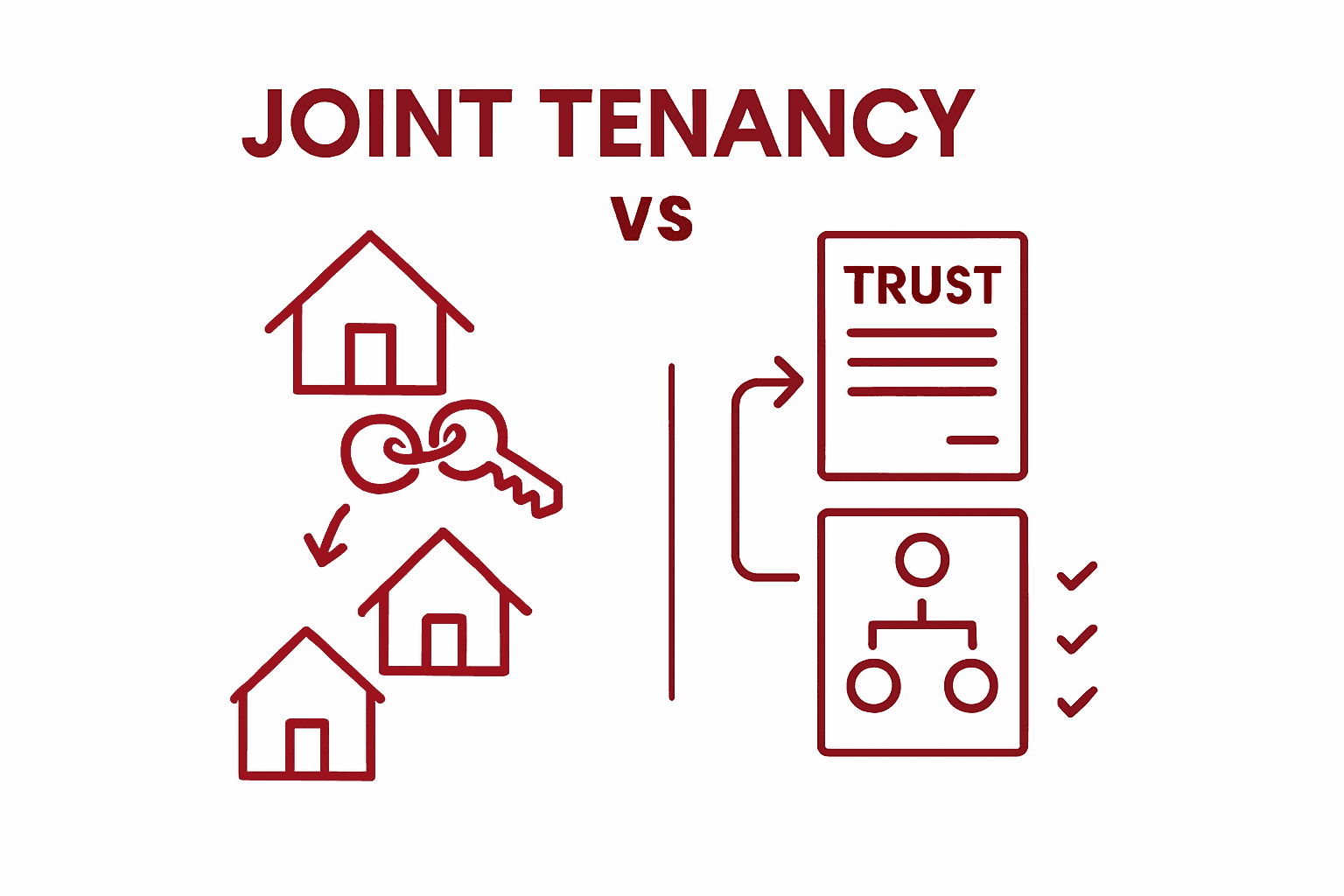
Here’s a summary comparing joint tenancy with living trusts for estate planning in California:
| Aspect | Joint Tenancy | Living Trust |
|---|---|---|
| Control Over Distribution | Minimal flexibility, transfers automatically | Full control, detailed instructions allowed |
| Probate Avoidance | Yes, via right of survivorship | Yes, avoids court process entirely |
| Privacy | Limited, transfer is recorded publicly | High, terms remain private |
| Protection from Creditors | Exposed to co-owner’s creditors | Can include asset protections |
| Suitability for Complex Needs | Not recommended | Ideal for blended families or special needs |
Pro Tip – Strategic Evaluation: Consult an estate planning professional to conduct a comprehensive analysis of your specific family situation, ensuring you select the most appropriate ownership strategy that aligns with your financial goals and familial needs.
Protect Your Family’s Future With Expert Estate Planning
Joint tenancy offers a way to avoid probate delays but also carries challenges like creditor risks and limited control over your property rights. If you want to protect your family from costly probate proceedings, unexpected legal complications, and financial uncertainties, having a well-crafted estate plan is essential. Understanding concepts like right of survivorship and the importance of clear ownership documentation can make all the difference in safeguarding your California property and legacy.

Don’t leave your family’s inheritance to chance. Explore comprehensive solutions in Estate Planning – Law Office of Eric Ridley that go beyond joint tenancy to secure your assets and ease the probate process. Our focused services in Probate – Law Office of Eric Ridley help you navigate legal complexities swiftly while protecting what matters most. Take control today by visiting Law Offices of Eric Ridley and schedule a consultation to design an estate plan tailored to your specific needs.
Frequently Asked Questions
What is joint tenancy in California?
Joint tenancy is a form of property ownership where two or more individuals hold equal interest in a property, with a right of survivorship that allows the property to automatically transfer to the surviving tenant(s) upon the death of one owner.
How does joint tenancy help avoid probate?
Joint tenancy helps avoid probate by enabling the automatic transfer of property ownership to the surviving joint tenant(s) without the need for court intervention, making the process quicker and less expensive.
What are the key rights and responsibilities of joint tenants?
Joint tenants have equal usage rights to the entire property, must share property-related expenses, make collective decisions on major actions, and benefit from the right of survivorship, which allows ownership to pass on without probate.
What are the risks associated with joint tenancy?
Risks include exposure to creditors of one joint tenant, potential complications in case of simultaneous deaths, and limited control over property shares, making it essential to carefully consider this arrangement in estate planning.
Recommended
- Real Estate in Probate: California Planning Guide for Wealthy Families 2026 – Law Office of Eric Ridley
- Real Estate Probate Sales in California: How Families Secure Their Wealth (2026 Guide) – Law Office of Eric Ridley
- Avoiding Probate Disputes in California: Protect Your Wealth in 2026 – Law Office of Eric Ridley
- Understanding Probate Process in California: 2026 Guide for Families and Homeowners – Law Office of Eric Ridley