Digital Assets After Death: The Numbers
1 in 5 American adults has used crypto
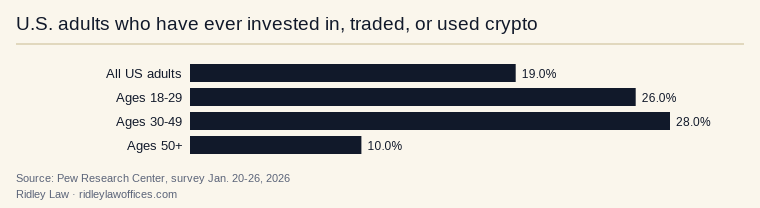
Pew Research Center found in January 2026 that 19% of American adults have invested in, traded, or used a cryptocurrency, up from 16% in 2021. That’s a measure of who has ever used it, not who holds it today.
Chainalysis, a blockchain analysis firm, estimated in 2020 that 3.75 million bitcoin had been lost, out of 18.27 million mined at the time. A coin whose private key nobody can find can’t be recovered by a court, a bank, or a family.
Who’s using crypto
| Group | Have ever used crypto (Pew, 2026) |
|---|---|
| Ages 18-29 | 26% |
| Ages 30-49 | 28% |
| Ages 50+ | 10% |
| Men | 27% |
| Women | 11% |
| Upper income | 27% |
| Middle income | 20% |
| Lower income | 16% |
Nearly half of adults have no instructions for their digital accounts
Trust & Will, an online estate planning company, surveyed 5,000 adults in early 2026 and found 48% have no instructions for what happens to their digital accounts when they die. Only 21% had formal written instructions. Read those as vendor survey figures. We couldn’t find a government or academic survey on the question.
The platform’s own tool comes first in California
California adopted the Revised Uniform Fiduciary Access to Digital Assets Act. Under it, the order of control works like this (Prob. Code, § 873):
- If the account offers an online tool and you used it, that direction controls. If the tool lets you change or delete the direction at any time, it overrides a contrary will, trust, or power of attorney.
- If you didn’t use an online tool, your will, trust, or power of attorney can allow or prohibit your executor’s or trustee’s access.
- Either one overrides the platform’s terms of service.
Google’s Inactive Account Manager and Apple’s Legacy Contact are online tools of this kind. Apple’s version requires the access key plus a death certificate.
None of this helps with crypto in a self-custody wallet. Without the key or seed phrase, there’s nothing for an executor or trustee to request.
If you have a trust, the free Trust Checkup gives you a plain-English summary of what it says, including whether it addresses digital assets.
Related pages on this site
- The California Crypto Graveyard: What Happens When Digital Wealth Dies With Its Owner
- Cryptocurrency Cold Wallet Probate Risk
- How Many People Have a Will? Estate Planning Statistics and What They Really Mean
- Estate Planning Statistics and California Guides
Sources and method
- Pew Research Center, “About 1 in 5 Americans have used crypto,” June 8, 2026 (survey January 20-26, 2026).
- Chainalysis, “WTF Is Going On in the Bitcoin Market?” March 18, 2020. https://www.chainalysis.com/blog/bitcoin-market-march-2020/. Chainalysis hasn’t posted a newer lost-bitcoin estimate on its own site. Later figures reported in the press use different definitions, so we haven’t used them.
- Trust & Will, 2026 Estate Planning Report (Talker Research, n=5,000, fielded January 28 to February 5, 2026). https://trustandwill.com/learn/estate-planning-report-2026
- Google Account Help, “About Inactive Account Manager”; Apple Support, “How to add a Legacy Contact for your Apple Account.”
Download the data: the CSV files in this folder hold the Pew, Chainalysis, and survey figures with their sources.
Use these numbers: You’re welcome to cite or embed the chart on this page with a link back to this page.
This page is general information, not legal or financial advice. Ridley Law is a California law firm. Practice limited to estate planning, trust administration, and uncontested probate.
Want a straight read on where you stand?
Talk to Eric. A free call, no pitch. He’ll tell you where you’re exposed, what it would cost to fix, and what you can skip.
Talk to Eric