Federal Estate and Gift Tax Exemption by Year, 1916 to 2027
This page lists the federal estate tax exemption, the top estate tax rate, the gift tax annual exclusion, the lifetime gift exemption and the generation-skipping transfer (GST) exemption for every year from 1916, when the modern estate tax began, through 2027. Every figure comes from the IRS: its Statistics of Income history of the estate tax for 1916 to 2009, and the annual revenue procedures and form instructions after that. We update it each November when the IRS announces the next year’s numbers.
Cite this page: Ridley Law, “Federal Estate and Gift Tax Exemption by Year, 1916 to 2027,” ridleylawoffices.com/estate-tax-exemption-history/, November 2026.
The exemption is $15,480,000 for deaths in 2027
Estates of people who die in 2027 can pass $15,480,000 free of federal estate tax, up from $15,000,000 in 2026. The IRS announced the 2027 figure in IR-2026-133 and Rev. Proc. 2026-35. A married couple can shelter twice that if the first spouse’s estate files a return and elects portability (26 U.S.C. § 2010(c)(4)-(5)). The gift tax annual exclusion rises to $20,000 per recipient in 2027, up from $19,000. Taxable gifts above the annual exclusion use up the same lifetime amount, and the GST exemption equals it (26 U.S.C. § 2631(c)). For what the 2027 numbers mean for a California plan, see What Changes for California Estate Plans in 2027 and Gift Tax in 2026 and 2027.
California has no estate tax or inheritance tax of its own, so for a California resident the federal exemption is the only one that matters. Our estate and inheritance tax by state table covers the states that do tax.
Every year since 1916
Read across a row for the rules in force for a death or gift in that year. “n/a” means there was no such tax or figure that year, or the IRS and Congressional Research Service sources don’t state it separately.
| Year | Estate tax exemption | Top estate tax rate | Gift tax annual exclusion (per recipient) | Lifetime gift exemption | GST exemption |
|---|---|---|---|---|---|
| 2027 | $15,480,000 | 40% | $20,000 | $15,480,000 | $15,480,000 |
| 2026 | $15,000,000 | 40% | $19,000 | $15,000,000 | $15,000,000 |
| 2025 | $13,990,000 | 40% | $19,000 | $13,990,000 | $13,990,000 |
| 2024 | $13,610,000 | 40% | $18,000 | $13,610,000 | $13,610,000 |
| 2023 | $12,920,000 | 40% | $17,000 | $12,920,000 | $12,920,000 |
| 2022 | $12,060,000 | 40% | $16,000 | $12,060,000 | $12,060,000 |
| 2021 | $11,700,000 | 40% | $15,000 | $11,700,000 | $11,700,000 |
| 2020 | $11,580,000 | 40% | $15,000 | $11,580,000 | $11,580,000 |
| 2019 | $11,400,000 | 40% | $15,000 | $11,400,000 | $11,400,000 |
| 2018 | $11,180,000 | 40% | $15,000 | $11,180,000 | $11,180,000 |
| 2017 | $5,490,000 | 40% | $14,000 | $5,490,000 | $5,490,000 |
| 2016 | $5,450,000 | 40% | $14,000 | $5,450,000 | $5,450,000 |
| 2015 | $5,430,000 | 40% | $14,000 | $5,430,000 | $5,430,000 |
| 2014 | $5,340,000 | 40% | $14,000 | $5,340,000 | $5,340,000 |
| 2013 | $5,250,000 | 40% | $14,000 | $5,250,000 | $5,250,000 |
| 2012 | $5,120,000 | 35% | $13,000 | $5,120,000 | $5,120,000 |
| 2011 | $5,000,000 | 35% | $13,000 | $5,000,000 | $5,000,000 |
| 2010 * | $5,000,000 | 35% | $13,000 | $1,000,000 | $5,000,000 |
| 2009 | $3,500,000 | 45% | $13,000 | $1,000,000 | $3,500,000 |
| 2008 | $2,000,000 | 45% | $12,000 | $1,000,000 | $2,000,000 |
| 2007 | $2,000,000 | 45% | $12,000 | $1,000,000 | $2,000,000 |
| 2006 | $2,000,000 | 46% | $12,000 | $1,000,000 | $2,000,000 |
| 2005 | $1,500,000 | 47% | $11,000 | $1,000,000 | $1,500,000 |
| 2004 | $1,500,000 | 48% | $11,000 | $1,000,000 | $1,500,000 |
| 2003 | $1,000,000 | 49% | $11,000 | $1,000,000 | $1,120,000 |
| 2002 | $1,000,000 | 50% | $11,000 | $1,000,000 | $1,100,000 |
| 2001 | $675,000 | 55% | $10,000 | $675,000 | $1,060,000 |
| 2000 | $675,000 | 55% | $10,000 | $675,000 | $1,030,000 |
| 1999 | $650,000 | 55% | $10,000 | $650,000 | $1,010,000 |
| 1998 | $625,000 | 55% | $10,000 | $625,000 | $1,000,000 |
| 1997 | $600,000 | 55% | $10,000 | $600,000 | $1,000,000 |
| 1996 | $600,000 | 55% | $10,000 | $600,000 | $1,000,000 |
| 1995 | $600,000 | 55% | $10,000 | $600,000 | $1,000,000 |
| 1994 | $600,000 | 55% | $10,000 | $600,000 | $1,000,000 |
| 1993 | $600,000 | 55% | $10,000 | $600,000 | $1,000,000 |
| 1992 | $600,000 | 55% | $10,000 | $600,000 | $1,000,000 |
| 1991 | $600,000 | 55% | $10,000 | $600,000 | $1,000,000 |
| 1990 | $600,000 | 55% | $10,000 | $600,000 | $1,000,000 |
| 1989 | $600,000 | 55% | $10,000 | $600,000 | $1,000,000 |
| 1988 | $600,000 | 55% | $10,000 | $600,000 | $1,000,000 |
| 1987 | $600,000 | 55% | $10,000 | $600,000 | $1,000,000 |
| 1986 | $500,000 | 55% | $10,000 | $500,000 | n/a |
| 1985 | $400,000 | 55% | $10,000 | $400,000 | n/a |
| 1984 | $325,000 | 55% | $10,000 | $325,000 | n/a |
| 1983 | $275,000 | 60% | $10,000 | $275,000 | n/a |
| 1982 | $225,000 | 65% | $10,000 | $225,000 | n/a |
| 1981 † | $175,000 | 70% | $3,000 | $175,000 | n/a |
| 1980 † | $161,000 | 70% | $3,000 | $161,000 | n/a |
| 1979 † | $147,000 | 70% | $3,000 | $147,000 | n/a |
| 1978 † | $134,000 | 70% | $3,000 | $134,000 | n/a |
| 1977 † | $120,000 | 70% | $3,000 | $120,000 | n/a |
| 1976 | $60,000 | 77% | $3,000 | $30,000 | n/a |
| 1975 | $60,000 | 77% | $3,000 | $30,000 | n/a |
| 1974 | $60,000 | 77% | $3,000 | $30,000 | n/a |
| 1973 | $60,000 | 77% | $3,000 | $30,000 | n/a |
| 1972 | $60,000 | 77% | $3,000 | $30,000 | n/a |
| 1971 | $60,000 | 77% | $3,000 | $30,000 | n/a |
| 1970 | $60,000 | 77% | $3,000 | $30,000 | n/a |
| 1969 | $60,000 | 77% | $3,000 | $30,000 | n/a |
| 1968 | $60,000 | 77% | $3,000 | $30,000 | n/a |
| 1967 | $60,000 | 77% | $3,000 | $30,000 | n/a |
| 1966 | $60,000 | 77% | $3,000 | $30,000 | n/a |
| 1965 | $60,000 | 77% | $3,000 | $30,000 | n/a |
| 1964 | $60,000 | 77% | $3,000 | $30,000 | n/a |
| 1963 | $60,000 | 77% | $3,000 | $30,000 | n/a |
| 1962 | $60,000 | 77% | $3,000 | $30,000 | n/a |
| 1961 | $60,000 | 77% | $3,000 | $30,000 | n/a |
| 1960 | $60,000 | 77% | $3,000 | $30,000 | n/a |
| 1959 | $60,000 | 77% | $3,000 | $30,000 | n/a |
| 1958 | $60,000 | 77% | $3,000 | $30,000 | n/a |
| 1957 | $60,000 | 77% | $3,000 | $30,000 | n/a |
| 1956 | $60,000 | 77% | $3,000 | $30,000 | n/a |
| 1955 | $60,000 | 77% | $3,000 | $30,000 | n/a |
| 1954 | $60,000 | 77% | $3,000 | $30,000 | n/a |
| 1953 | $60,000 | 77% | $3,000 | $30,000 | n/a |
| 1952 | $60,000 | 77% | $3,000 | $30,000 | n/a |
| 1951 | $60,000 | 77% | $3,000 | $30,000 | n/a |
| 1950 | $60,000 | 77% | $3,000 | $30,000 | n/a |
| 1949 | $60,000 | 77% | $3,000 | $30,000 | n/a |
| 1948 | $60,000 | 77% | $3,000 | $30,000 | n/a |
| 1947 | $60,000 | 77% | $3,000 | $30,000 | n/a |
| 1946 | $60,000 | 77% | $3,000 | $30,000 | n/a |
| 1945 | $60,000 | 77% | $3,000 | $30,000 | n/a |
| 1944 | $60,000 | 77% | $3,000 | $30,000 | n/a |
| 1943 | $60,000 | 77% | $3,000 | $30,000 | n/a |
| 1942 | $60,000 | 77% | n/a | n/a | n/a |
| 1941 | $40,000 | 77% | n/a | $40,000 | n/a |
| 1940 | $40,000 | 70% | n/a | $40,000 | n/a |
| 1939 | $40,000 | 70% | n/a | $40,000 | n/a |
| 1938 | $40,000 | 70% | n/a | $40,000 | n/a |
| 1937 | $40,000 | 70% | n/a | $40,000 | n/a |
| 1936 | $40,000 | 70% | n/a | $40,000 | n/a |
| 1935 | $40,000 | 70% | n/a | $40,000 | n/a |
| 1934 | $50,000 | 60% | n/a | $50,000 | n/a |
| 1933 | $50,000 | 45% | n/a | $50,000 | n/a |
| 1932 | $50,000 | 45% | $5,000 | $50,000 | n/a |
| 1931 | $100,000 | 20% | n/a | n/a | n/a |
| 1930 | $100,000 | 20% | n/a | n/a | n/a |
| 1929 | $100,000 | 20% | n/a | n/a | n/a |
| 1928 | $100,000 | 20% | n/a | n/a | n/a |
| 1927 | $100,000 | 20% | n/a | n/a | n/a |
| 1926 | $100,000 | 20% | n/a | n/a | n/a |
| 1925 | $50,000 | 40% | $500 | $50,000 | n/a |
| 1924 | $50,000 | 40% | $500 | $50,000 | n/a |
| 1923 | $50,000 | 25% | n/a | n/a | n/a |
| 1922 | $50,000 | 25% | n/a | n/a | n/a |
| 1921 | $50,000 | 25% | n/a | n/a | n/a |
| 1920 | $50,000 | 25% | n/a | n/a | n/a |
| 1919 | $50,000 | 25% | n/a | n/a | n/a |
| 1918 | $50,000 | 25% | n/a | n/a | n/a |
| 1917 | $50,000 | 25% | n/a | n/a | n/a |
| 1916 | $50,000 | 10% | n/a | n/a | n/a |
* 2010: the default law was a $5,000,000 exemption and a 35% top rate, but an executor could elect out of the estate tax entirely and take modified carryover basis instead (Form 706 instructions, 2010). The GST tax rate for 2010 was zero.
† 1977 to 1981: the unified credit replaced the flat exemption in 1977. These are the IRS’s rounded exemption equivalents of the credit.
Four turning points
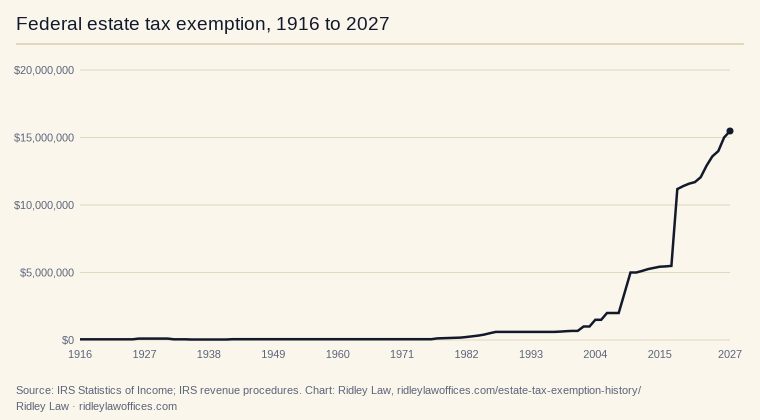
1942 to 1976: a $60,000 exemption that never moved. The exemption sat at $60,000 for 35 years while the top rate held at 77% from 1941 through 1976. Inflation eroded it every year, so the same exemption covered less and less of a typical estate.
1977: one tax on gifts and estates. The Tax Reform Act of 1976 unified the gift and estate taxes under a single credit. The GST tax followed, with a $1,000,000 exemption from 1987.
2001 to 2010: the phase-up and the gap year. The exemption climbed from $675,000 in 2001 to $3,500,000 in 2009 while the gift exemption stayed at $1,000,000. Then came 2010, the one year an estate could choose no estate tax at all.
2018 and 2026: doubling, then a new base. The 2017 tax act roughly doubled the exemption to $11,180,000 for 2018. The 2025 law set $15,000,000 for 2026 and indexed it for inflation from 2027 on (26 U.S.C. § 2010(c)(3)). The top rate has been 40% since 2013 (26 U.S.C. § 2001(c)).
For how many estates file and pay today, see our estate tax statistics. If your estate is near the line, run it through the estate tax exposure calculator.
Related pages on this site
- Estate Tax Statistics (2026): 36 Verified Figures With Sources
- Estate Tax Portability in California: The 706 Most Families Skip
- Form 709: The Federal Gift Tax Return, Explained
- Generation-Skipping Transfer Tax: Definition and How It Works in California
- Ultra-High-Net-Worth Estate Planning in California
- Estate and Inheritance Tax in California
- Estate Planning Statistics and California Guides
Sources and method
- 1916 to 2009, estate exemption and top rate: IRS Statistics of Income, “The Estate Tax: Ninety Years and Counting,” Figures D and E (SOI Bulletin, 2007). https://www.irs.gov/pub/irs-soi/ninetyestate.pdf
- 1925 to 1998, gift tax figures: Congressional Research Service, Report 95-444, “A History of Federal Estate, Gift, and Generation-Skipping Taxes” (January 2011).
- 1999 to 2012, annual exclusion and GST exemption: IRS, Instructions for Form 709 for each year. 2010 and 2011 to 2013 rates: IRS, Instructions for Form 706 for each year.
- 2011 to 2027: IRS, “What’s new: Estate and gift tax,” and the annual inflation revenue procedures (Rev. Proc. 2011-52, 2013-35, 2014-61, 2015-53, 2016-55, 2018-18, 2018-57, 2019-44, 2020-45, 2021-45, 2022-38, 2023-34, 2024-40, 2025-32 and 2026-35); IRS News Release IR-2026-133 (November 2026).
- Statutes: 26 U.S.C. §§ 2001(c), 2010(c), 2503(b) and 2631(c).
- Gift figures for 1933 to 1934 and 1936 to 1941 are carried forward from the 1932 and 1935 Acts, as CRS describes them by act rather than by year. The 1933 to 1942 annual exclusion isn’t shown because the sources we read state only the 1932 figure.
- Figures are nominal dollars, not adjusted for inflation. Spot an error? Email eric@ridleylawoffices.com.
Download the data: estate-tax-exemption-history-data.csv
Use these numbers: You’re welcome to cite this table or embed the chart with a link back to this page.
This page is general information, not legal or tax advice. Ridley Law is a California law firm. Practice limited to estate planning, trust administration, and uncontested probate.
Want a straight read on where you stand?
Talk to Eric. A free call, no pitch. He’ll tell you where you’re exposed, what it would cost to fix, and what you can skip.
Talk to Eric