Prop 19 by the Numbers: Parent-Child Property Tax Transfers Since 2021
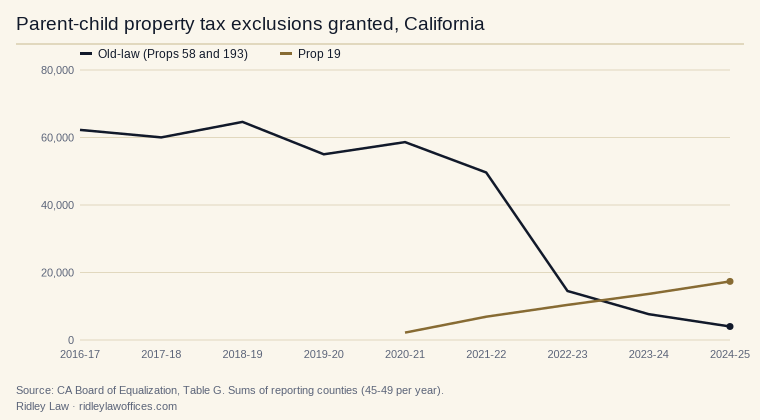
Parent-child property tax exclusions fell by two-thirds after Prop 19
California county assessors granted 64,610 parent-child exclusions in fiscal year 2018-19, under the old rules of Props 58 and 193. In 2024-25 they granted 21,363: 17,372 under Prop 19 and 3,991 under the old rules for transfers made before the cutoff.
Before February 16, 2021, a parent could pass a home of any value, plus up to $1 million of other California real property’s assessed value, to a child without reassessment (Rev. & Tax. Code, § 63.1, subd. (a); Cal. Const., art. XIII A, § 2.1). Prop 19 limited the exclusion to a family home the child moves into, or a family farm, and capped it (Rev. & Tax. Code, § 63.2).
Prop 19 exclusions have grown every year since 2020-21
| Fiscal year | Old-law (Props 58 and 193) | Prop 19 | Counties reporting |
|---|---|---|---|
| 2016-17 | 62,251 | 48 | |
| 2017-18 | 60,043 | 49 | |
| 2018-19 | 64,610 | 49 | |
| 2019-20 | 55,022 | 47 | |
| 2020-21 | 58,649 | 2,201 | 47 |
| 2021-22 | 49,639 | 6,907 | 45 |
| 2022-23 | 14,519 | 10,408 | 49 |
| 2023-24 | 7,635 | 13,662 | 45 |
| 2024-25 | 3,991 | 17,372 | 48 |
Old-law exclusions after 2021 are late claims for transfers made before the February 16, 2021 cutoff. Not every county reports every year, so the totals cover 45 to 49 counties.
Ventura County’s exclusions fell by more than two-thirds
Ventura County’s assessor granted 2,063 parent-child exclusions in 2018-19. In 2024-25 the count was 625: 373 under Prop 19 and 252 under the old rules.
Ventura County voters approved Prop 19 by 205,630 to 203,320, or 50.3%. Statewide it passed with 51.1%.
The exclusion cap is $1,044,586 through February 15, 2027
If the home’s market value at transfer is less than its taxable value plus $1 million (adjusted every two years), the child keeps the parent’s taxable value. If it’s more, the excess is added to the assessment (Rev. & Tax. Code, § 63.2, subd. (d); Cal. Const., art. XIII A, § 2.1, subd. (c)). For transfers from February 16, 2025 through February 15, 2027, the adjusted amount is $1,044,586.
The child has to make the home their principal residence within a year and file for the homeowners’ or disabled veterans’ exemption within a year of the transfer (Rev. & Tax. Code, § 63.2, subd. (a)(1)(A)-(B)). The claim has to be filed within three years of the transfer, before the home is transferred to a third party, or before the child stops living there, whichever comes first. A late claim can still apply starting with the tax year it’s filed (Rev. & Tax. Code, § 63.2, subd. (f)).
What the change is worth to local government
In October 2025, the Legislative Analyst’s Office estimated that reversing Prop 19’s inheritance changes would cost schools and local governments around $1 billion a year at first, growing to around $2 billion a year.
For families, the planning question is whether a child will live in the house. If not, the home is reassessed at market value when it passes. If you have a trust, the free Trust Checkup gives you a plain-English summary of what it says about the house.
Related pages on this site
- Prop 19 Parent-Child Exclusion: What It Takes to Keep the Tax Base
- Prop 19 and the Inherited House: How Reassessment Works
- Prop 19 Planning for Ventura, Santa Barbara, and Los Angeles Counties
- Estate Planning Statistics and California Guides
Sources and method
- California State Board of Equalization, open data, Table G (legal entity, parent-child, and Prop 19 exclusions by county), fiscal years 2013-14 through 2024-25. Statewide totals are Ridley Law’s sums of the counties reporting each year.
- California State Board of Equalization, Letter To Assessors No. 2025/009 (March 7, 2025). https://www.boe.ca.gov/proptaxes/pdf/lta25009.pdf
- Legislative Analyst’s Office, letter of October 22, 2025, on the fiscal effect of reversing Prop 19’s intergenerational transfer changes.
- California Secretary of State, Statement of Vote, November 3, 2020 General Election.
- The 67% drop is Ridley Law’s arithmetic: 21,363 in 2024-25 against 64,610 in 2018-19. The two years cover 48 and 49 reporting counties.
Download the data: exclusion-amount.csv · exclusions-by-county-and-year.csv · vote.csv
Use these numbers: You’re welcome to cite or embed the chart on this page with a link back to this page.
This page is general information, not legal or tax advice. Ridley Law is a California law firm. Practice limited to estate planning, trust administration, and uncontested probate.
Want a straight read on where you stand?
Talk to Eric. A free call, no pitch. He’ll tell you where you’re exposed, what it would cost to fix, and what you can skip.
Talk to Eric