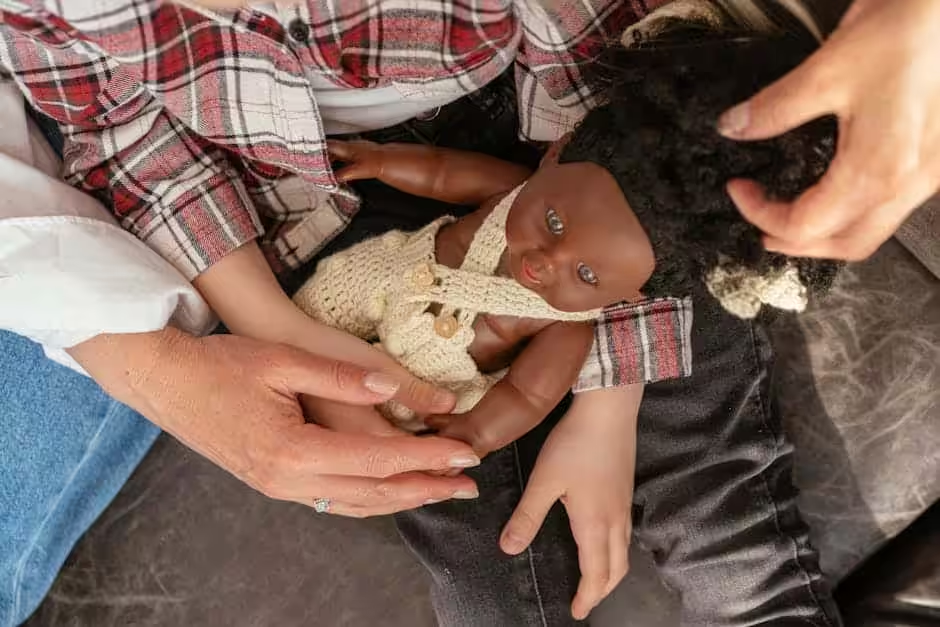
Short answer – In California, a guardianship is a court appointment of someone to care for a minor child, the child’s property, or both (Prob. Code §1514). A Camarillo family starts one by petition in Ventura County Superior Court, the county where the child lives (Prob. Code §2201). Parents can nominate a guardian ahead of time in a will or other signed writing (Prob. Code §1500, §1502), and the court must give that nomination due weight (Fam. Code §3043).
My practice is estate planning, which includes naming a guardian for your minor children so a judge isn’t left to choose one without your input. I don’t handle guardianship proceedings. If you need to petition for guardianship of a child now, I can refer you to counsel who handles those cases.
Law verified against Probate Code §§1490, 1500 to 1514, 1600, 1601, 1801, 2105, 2201, 2250, 3401 and 3920, and Family Code §§3040, 3043 and 6550, 2026. This page is general information about California law and doesn’t give legal advice for your situation.
California uses guardianship for children and conservatorship for adults
People often use “guardianship” for an aging parent or an adult with a disability. California law doesn’t. When a statute refers to a guardian of an adult, it means that adult’s conservator (Prob. Code §1490). A conservator of the person may be appointed for an adult who can’t provide for their own health, food, clothing or shelter, and a conservator of the estate for an adult substantially unable to manage their finances or resist fraud or undue influence (Prob. Code §1801).
Adults can usually avoid conservatorship with planning done while they still have capacity. A durable power of attorney keeps working after incapacity (Prob. Code §4124), and a power of attorney for health care lets an agent make medical decisions (Prob. Code §4671). More on that at incapacity planning in California.
Without a nomination, a judge picks your children’s guardian
If your children are minors and you don’t have a will naming a guardian, a judge will pick one if something happens to both parents, guided by the custody preferences described below (Fam. Code §3040).
With no will or trust, property passes by intestacy, and a surviving spouse’s children take the rest after the spouse’s share (Prob. Code §6401, §6402), and a minor’s inherited share may then need a guardianship of the estate to manage it. The page on what happens without a trust shows how that plays out.
How a guardianship reaches a Ventura County judge
Guardian of the person and guardian of the estate
A guardianship can cover the child’s care, the child’s money, or both, and they don’t have to be held by the same person. The court can appoint a guardian of the person, a guardian of the estate, or both (Prob. Code §1514).
- Guardian of the person handles the child’s day-to-day care: where the child lives, school, medical decisions.
- Guardian of the estate manages money and property the child owns, such as an inheritance or insurance proceeds, under court supervision.
A parent may nominate one guardian for the person and another for the estate (Prob. Code §1500).
Who files, and where
A guardianship starts with a petition from a relative, any other person on behalf of the child, or the child if 12 or older (Prob. Code §1510). The petition names the proposed guardian and states that the appointment is necessary or convenient (Prob. Code §1510). The proper county is where the child lives, or another county if that’s in the child’s best interests (Prob. Code §2201). For a child living in Camarillo, that’s Ventura County Superior Court.
Investigation, and a temporary guardian if the child needs one now
Each proposed guardianship gets an investigator’s report and recommendation unless the court waives it for good cause. A court investigator handles cases with a relative as proposed guardian, and the county agency that investigates potential dependency handles nonrelatives (Prob. Code §1513). If the child needs someone with authority right away, a temporary guardian can be requested once the petition is filed, to serve until the court decides the main petition (Prob. Code §2250).
How the judge decides
For a guardian of the person, the judge follows the Family Code custody rules (Prob. Code §1514), and a parent’s nomination counts at the second and third levels. The court may appoint a guardian if it appears necessary or convenient (Prob. Code §1514). Custody goes to a parent first. If not to a parent, it goes to the person in whose home the child has been living in a wholesome and stable environment, and then to any other suitable person (Fam. Code §3040). The court must give due weight to a parent’s nomination at those second and third levels (Fam. Code §3043).
- A relative, any other person on behalf of the child, or the child if 12 or older files a petition.
- The petition goes to the county where the child lives. For a child living in Camarillo, that’s Ventura County Superior Court.
- An investigator’s report and recommendation is prepared unless the court waives it for good cause.
- If the child needs someone with authority right away, a temporary guardian can be requested once the petition is filed.
- The judge decides. Custody goes to a parent first, then the person in whose home the child has been living, then any other suitable person.
A parent’s nomination carries weight with the judge
A parent may nominate a guardian of the person or estate of a minor child when the other parent agrees to the same nominee, or when, at the time of the petition, the other parent has died, lacks capacity to consent, or wouldn’t need to consent to an adoption (Prob. Code §1500).
In practice, the nomination goes in a will, though California accepts it in the petition, at the hearing, or in a signed writing made before or after the petition is filed (Prob. Code §1502). The nomination can be made effective only on a condition you specify, such as your death or incapacity, and unless it says otherwise it stays effective after you die or lose capacity (Prob. Code §1502).
The court must appoint the person a parent nominated as guardian of the estate unless it finds the nominee unsuitable (Prob. Code §1514). Anyone, including a grandparent, can also nominate a guardian for property they leave to a child (Prob. Code §1501), and the court must appoint that nominee for that property unless unsuitable (Prob. Code §1514).
When I draft a plan for parents, the guardian nomination goes in the will, with alternates. I also recommend telling the people you’ve named. The article on talking to your family about your estate plan covers how. See naming a guardian for your children and the Camarillo guardian nomination page for more.
If a parent is terminally ill
A custodial parent diagnosed with a terminal condition, documented by a physician’s declaration, can ask the court to appoint that parent and a person they nominate as joint guardians of the child (Prob. Code §2105). This lets the future guardian step in with authority already in place, subject to the court’s discretion and the limits in the statute.
Keeping a child’s inheritance out of a court guardianship
A guardianship of the estate means court supervision of the child’s money until the child turns 18, with narrow exceptions (Prob. Code §1600). For a three-year-old who inherits, that is fifteen years of court oversight of the money. It also ends on the child’s adoption, emancipation or death (Prob. Code §1600). Before then, the guardian, a parent or the child can petition to end it, and the court may terminate it if that’s in the child’s best interest (Prob. Code §1601).
Small amounts can go to a parent. If the child’s total estate is $5,000 or less, money can be paid to a custodial parent to hold for the child, on the parent’s verified written assurance (Prob. Code §3401).
UTMA custodians can hold property past 18. Property left to a custodian under the California Uniform Transfers to Minors Act passes to the child at 18 by default (Prob. Code §3920), or at a later age up to 25 if the will or trust specifies it (Prob. Code §3920.5).
A trust keeps the money out of court and lets you pick the ages. A trust for the children lets a trustee you choose manage the money, with no court involvement, and distribute it at the ages you pick. The article on who controls a minor’s inheritance compares these options. For a child with a disability, a special needs trust protects eligibility for public benefits.
A relative caring for a child may not need a guardianship
For short arrangements, a caregiver’s authorization affidavit is often enough. A caregiver can use it to enroll a child in school and consent to school-related medical care, and a relative caregiver who completes the relative portion of the form gets the same medical and dental consent rights a guardian has (Fam. Code §6550). A parent’s contrary decision controls unless it would jeopardize the child’s life, health or safety (Fam. Code §6550).
How I plan this with Camarillo parents
For Camarillo parents, I put the guardian nomination and alternates in the will and pair it with a trust that holds the children’s inheritance until the ages you choose. We plan by phone and Zoom, and a mobile notary comes to your home for signing. More at the Camarillo estate planning page.
Frequently asked questions
Is guardianship always needed when a relative is caring for a child?
No. A caregiver can use a caregiver’s authorization affidavit to enroll a child in school and consent to school-related medical care, and a relative caregiver who completes the relative portion of the form gets the same medical and dental consent rights a guardian has (Fam. Code §6550).
How long does a guardianship last?
A guardianship of the person or estate ends when the child turns 18, with narrow exceptions (Prob. Code §1600). It also ends on the child’s adoption, emancipation or death (Prob. Code §1600).
Want a straight read on where you stand?
Talk to Eric. A free 30-minute call, no pitch. He’ll tell you where you’re exposed, what it would cost to fix, and what you can skip.
Talk to Eric